My heartfelt thanks to Hilary Hart and the San Francisco Film Society for granting me 15 minutes to talk to Fernando Solanas [official Spanish website], director of The Dignity of the Nobodies (La dignidad de los nadies, 2005), which had its U.S. premiere at the 49th edition of the San Francisco International Film Festival (SFIFF) in association with the United Nations Association Film Festival and Global Exchange [my earlier write-up is here]. What a welcome opportunity! With my broken Spanish and the able translations of Oscar Arteta, I was able to touch upon a few points with Solanas.
* * *
 Michael Guillén: When I first saw Dignity of the Nobodies, I was both sad and hopeful; sad because it seemed to me something that could happen to U.S. citizens if we aren't careful and vigilant, and hopeful because the Argentines are setting an example of what people can do in such a crisis. Do you remain hopeful? As hopeful as when you were making the documentary?
Fernando Solanas: Yes, of course. Yes, yes.
Guillén: What can people in the United States do to help the Argentine people in this situation?
Solanas: Look, one of the things that occurs to me—we were talking about it earlier today—is of course the development of different kinds of information because the information given by this film does not reach the media, it doesn't arrive to you. The U.S. society is a very misinformed society. They end up thinking that in Argentina nothing happens, there's no reaction. It's a scandal to me! I see in all the press here there is no news about Latin America and in all our countries every day things are happening. There's nothing more dangerous than censorship and the lack of information, because those are the same mediums through which demons are invented.
 Of course, people read inbetween the lines, search on the web, in magazines, to find other information but the majority are victims of this censorship and lack of information. So what do you do to make the information system in North America and the United States more democratic? How do you change it? Nothing happens, it's terrible! It's been a week since I've been here. I started in L.A. I spend many hours in the hotel and at night I don't go out; I stay in the hotel. It's sad, the misinformation, or the lack of information, how poor the newscasts are. On the other hand, there are no alternative distribution systems or channels for a film like The Dignity of the Nobodies.
Guillén: Is this what you mean by the "culture of defeat"?
 Solanas: Oh yes, of course, of resignation, of giving up, of believing it is impossible to bring about change, that the neoliberal movement cannot be changed, that globalization cannot be changed.
Guillén: That's what was so inspiring to me about the documentary: it provided a model of change.
Solanas: Of course.
Guillén: I saw the film more as a radical poem than a documentary. It reminded me of a short poem by Antonio Machado. Do you know Machado?
Solanas: Yes….
Guillén: Do you know this poem? [I recite in Spanish]: El ojo que ves no es / ojo porque tú lo veas / es ojo parque te ve. [His eyebrows lift and he nods his head approvingly.] What this reminds me of in your work is how—as a documentary filmmaker—you don't just observe, you allow the people you're filming to become real and engaged, you grant them sovereignty. I understand that when you were filming The Dignity of the Nobodies, you had to change cameras in order to achieve that communication, switching from a larger shoulder-borne camera to a handheld. Can you speak about the uses of various cameras to create a more realistic portrait?
 Solanas: Well, in this movie Dignity, there are nine minutes of archived material that I did not film. The rest, an hour and 50 minutes, is material that I filmed myself looking to find the same cinematic language. Most of it is like a very subjective camera living alongside the people. It's a camera with a wide-angle lens that is always in my hand. Half of this film is filmed with this little camera [he shows me a photo of a mini-DV] and the other half is filmed with a Sony DVcam 150, which is also a small camera.
Guillén: But the smaller one worked better to establish friendship and cooperation?
Solanas: They're both cameras that people don't regard as professional cameras from television. Aside from that, the people know me, they have affection for me, they respect me, they know that I make movies that express them very well.
 Guillén: I was interested also that you brought back the tradition of the copla to introduce each character. Can you talk a little bit about the payador tradition and why you use it?
Solanas: In the popular tradition in the 19th century there was the payador, he was like the one that chronicled life on the pampas. He would ride around the countryside on his horse with his guitar and when he would get to a puntenilla, which was like a mixture of a meat market and a corner store in the middle of nowhere, it was like a house where a gaucho could go, he would have a drink, and tell stories, his chronicles, for the coins people would give him. But he would tell his news with some kind of art; it was the art of popular poetry.
Guillén: The combination of the two—your using modern, small cameras to capture campesino testimonials while utilizing this ancient payador tradition—was fantastic!
 Solanas: I thought it was necessary to have a more sensitive level, a synthesis, to summarize and introduce each one of these stories, especially the characters. So each character has a copla that follows the tradition of the gaucho poetry, which was initiated by Martín Fierro. Martín Fierro is the poem that is most well-known and the most beautiful poem of all Argentine poetry, written in 1872, and it talks about the odyssey of a gaucho who was persecuted. The army used to go to the pampas and try to inscript the gauchos—who were free—to go and fight against the Indians, the natives. Gauchos and Indians, they lived in peace before. So this is the poem and The Dignity of the Nobodies follows that tradition, but with a more simplified language, one that is more urban. Though not exactly, it approximated the gaucho language and in that way each character was introduced with verses. I like it because it creates a certain environment, it gives a heightened level of sensitivity. Some people don't like it at all but, inside of a work of art you can have different levels of language.
Guillén: Yes, the film is multi-layered.
Solanas: Exactly! That's the way it is.
Guillén: You have stated that you are hoping "to preserve memory against oblivion." So it seems to me that you're saying memory is a political act that counters the systematic erasure of history.
Solanas: Memory is good. In the '90s until now the media in Argentina has lied a lot, has falsified history. The media is financed by big corporations and the banks. Hence, it was necessary to make a film of opinions that would analyze what had happened and why. Of course for the economic powers of neoliberalism, the banks and all of them, this film is just pure trash.
Guillén: But we know better!!
 Solanas: [Chuckling.] I'm making these films and trying to chronicle history. They're films that over there will be more or less public but they will last because they are real testimonies. At the same time, I want to—because I am making a movie—I want to write it very well, to film it well, because the same information could be taught by a professor in history or sociology. It would have the same information but without the emotional impact. This movie, The Dignity of the Nobodies and its predecessor A Social Genocide [Solanas actually translates it as Memories of a Plunder], they have been declared in Argentina to be of educational interest. So with regard to the news that the teacher can bring his students, now all the students can bring him to see the film, and then have a debate over it. More than 40,000 students in high school have seen Memories of a Plunder—that's high school students!!—through a program that allows low ticket prices, almost nothing. The programs are aided by the Ministry of Education or the Institute of Film.
Guillén: Well, they're telling me I have to wrap it up here. Before parting, I must say that I consider you a magnificent teacher!! Thank you for your all your work.
[Solanas then asked if he could take a look at my digital recorder. He was fascinated by it. He asked me how it worked, if it had a cassette, and I told him, no, that it recorded digitally with a memory stick and that I could then upload the recording to my computer for transcription. He asked if he could hear what I had recorded and I played it back for him to listen. He whistled approvingly. I told him that, if I had two of them, I would gladly give him one. Next time!! We laughed.]
05/13/06 UPDATE: Josh Wolf at The Revolution Will Be Televised filmed Fernando Solanas during his Q&A following the SFIFF screening of The Dignity of the Nobodies. David D'Arcy interviewed Solanas for The Greencine Daily.
Cross-published on Twitch.
 The U.S. premiere of Fernando Solanas' The Dignity of the Nobodies (La dignidad de de los nadies, 2005) is being presented at the 49th edition of the San Francisco International Film Festival in association with the United Nations Association Film Festival and Global Exchange. The second in a projected series of four documentaries dealing with the plight of Argentina, The Dignity of the Nobodies is—as Miguel Pendás pens for the program catalog—"activist cinema at its best: passionate, informative and uncompromising." Pendás concludes: "The film's power and immediacy make it feel like a hopeful forecast of things to come."
Imagine! A documentary that testifies to hope!! The Dignity of the Nobodies has arrived on these bleak shores none too soon.
 "It was hard to imagine," Solanas writes regarding the genesis of the documentary, "that the small women farmers, ignorant of banking or political affairs, would be able to organize a vigorous and original resistance movement confronting banks and stopping over a thousand auction sales. The neighborhood or community soup kitchens, community clinics, bakeries and other social initiatives created by the neighbors to give an answer to poverty and hunger. The dozens of silence marches staged by relatives of the victims of police mafias which managed to unmask the murderers and send them to trial. The factories revived by their former workers showing that under self-management and without the hierarchical structures of managers and foremen, they could produce with efficiency and quality."
All these "stories" are passionately recorded in The Dignity of the Nobodies and any American—fearful of where our so-called leaders are taking this country—should become cognizant of these grass root strategies and project their own future involvement into them.
Where a feature film like Obaba creates a narrative fiction out of the documentary process, Solanas inverts the assertion: "The Dignity of the Nobodies is not only testimonial cinema, it is not fiction either. It starts from reality but uses procedures from other genres, and on telling characters' facts and stories it approaches fiction. In The Dignity of the Nobodies I tried to fuse genres, to approach real facts to narrative stories, to use procedures of the documentary together with those of fiction or of essay cinema. Its narrative structure resembles that of an open book with tales, chronicles and stories, looking for the testimonial to blend with the poetic, the essay with the testimonies, and the characters with life. The idea of the genres has been reversed and the limits between fiction and the documentary cinema are difficult to specify."
 Whereas I was entertained by the stately whimsy of Obaba, and its play on who is seeing who, it remains a philosophical reverie on structures of memory, an artistic construct I can look at, enjoy, write about, and ultimately dismiss. With The Dignity of the Nobodies, however, memory and the documentary process forge a progressive alliance, engaging me at a deep level. "The tragedy," Solanas explains, "pushed me to preserve memory against oblivion." These stories are not philosophical musings; they are practical stratagems for survival! Here, voting is accomplished with the feet, with action, and not by passive cooperation with structured party politics. Here, Basta! Becomes a rallying cry. Enough! Enough.
But it is precisely by his bringing the resistance down to personal testimonials that Solanas has achieved universality and solidarity. Each character—Martin, the writer delivery-rider, Toba the teacher, Antonia and Chipi who run the poor soup kitchen, Margarita and Colinche who provide for their children through scavenging and gleaning, Silvia and Carola in the public hospital, Lucy who organized farmer wives against the banks' auctions of their farms, Dario martyred by the police mafia and Claudia his fiance, Gustavo, the young priest turned social reactionary—are introduced via coplas, which have their origin in the 19th century payada. The payador was the chronicler gaucho who traveled through the pampa passing on the news in verse to the music of his guitar.
I was entertained by Obaba; but, I was profoundly moved by The Dignity of the Nobodies. A must-see at this year's festival!
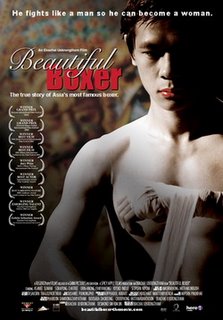 I've seen Ekachai Uekrongtham's Beautiful Boxer twice, first at the 47th San Francisco International Film Festival on April 18, 2004. At that time, I wrote:
Even Roger Garcia had trouble pronouncing Ekachai Uekrongtham's name when introducing him to his Castro Theater audience for last night's U.S. premiere screening of Beautiful Boxer. Uekrongtham admitted he had no idea when he made this film that it would travel as far as it has and originally worried that there would only be two people in his audience.
Uekrongtham's debut feature film is held aloft by the sincere, superb performance of Sanee Suwan in the role of Parinya Charoenphol (more generally known as Nong Toom). Suwan was named Best Boxer by the Association of Muay Thai (i.e., Thai kickboxing) for the northern region of Thailand in 2001 and this skill was beautifully evident in the film's boxing sequences, which really were quite exciting to watch.
The movie starts out with a kick. A journalist is trying to chase down Nong Toom to interview her, accidentally knocks over a woman whose hulky boyfriend rises to her defense, and before you know it the poor journalist is being used as a punching bag until, pow, here comes Nong-Toom kicking these thugs into submission and landing squarely on her high heel spikes. Such gynandrous exaggerations prove thrilling!!
It's hard not to like this movie. It's balanced so well between truth and prurience. It certainly seems to confirm Variety reviewer Russell Edwards' suspicion that Thailand is trying to "corner the market in gay-themed sports movies" and his projection that it "should K.O. predisposed auds, providing modest niche B.O." Without a doubt. But his further honesty in stating the film is "sweetly entertaining but bland" warns that, where it caters to a beautiful surface, it eschews the depths that could have made this a profound examination of cultural attitudes towards gender as well as internalized gender conflict. Everything is made so easy for Nong Toom to become the woman he wishes to be that the dramatic tension of his quest is weakened, much like the hormone pills that weakened his virility.
That weakened tension, however, is reinforced by the cameo appearance of Nong Toom herself in the final scenes of the movie, where she appears on a palanquin supported by several muscled men and offers sweet advice to a young kickboxer who has been forced to wear make-up to entertain her. She wipes off his lipstick and tells him to fight from his heart.
This, I would say, is the aspect of the movie that I found most powerful. When Nong Toom is a boy and sent away to the monastery, he sneaks out to work for a living to support a crippled father and an interred mother. When he can no longer find work to support his parents, he sits on some steps to cry. He is spotted by a transvestite who feeds him, finds him work, helps care for his parents, guides him to a wandering monk for further training, and shows him that his dream is accessible, that he can be like her if he wishes. That later in the film he then offers the same assistance to a young boy connotes the subcultural continuity that has helped so many gender-variant men and women to survive in a world where parents often forsake them, schools miseducate them, and governments punish them for aspiring towards the love and union given to other citizens.
Too often criticism is aimed at older men or women who take a youngster underwing. Sexual irresponsibility is more often than not projected upon them, when in truth what is more truthfully going on is a process of acculturation into a subculture whereby such a fragile spirit in such a young body can survive. This is one of the first foreign films where I have seen the continuity of this tradition so tenderly depicted.
It also deserves praise for joining ranks with cinematic depictions of gender variant individuals who fight for themselves—in this film literally—proving they are not victims, despite those who would wish to make them so in order to retain the comfort of their own narrow identities.
 And it promises to each individual the wealth of their own sovereignty and their own self-expression, wherever it lies on the vast continuum of gender expression. In the final scenes where the real Nong Toom is shown at her vanity with actor Suwan stepping away into the background, we have a momentary sense of the internalized gender conflict that could have enrichened this movie even further. You no longer need me, the kickboxer smiles, you have become who you wanted to be, achieved what you wanted to achieve. But even so, she doesn't quite want to let go of this muscular young man who fought for himself. You don't have to, he reminds her, I will always be within you. The true and beautiful sygyzy.
Then I had a second opportunity to see Beautiful Boxer at an advance screening of its theatrical distribution in January 2005. I wrote then:
Attended a Film Society screening of Beautiful Boxer at the Lumiere with director Uekrongtham, actor Asanee Suwan and the film's subject Nong Toom, in attendance to promote the launch of the film's U.S. distribution. It was one of those singularly unique cinematic evenings in San Francisco that challenges my intellect even as it invigorates my soul.
Coincidentally, earlier in the afternoon while perusing the Intersections website, I came across an essay by Graeme Storer entitled "Performing Sexual Identity: Naming and Resisting 'Gayness' in Modern Thailand" in which Storer credited Parinya's appearance in the kickboxing arena as one of two critical events that has helped to shape Thai understanding of gender and sexuality. Storer's essay greatly enhanced my second viewing of Beautiful Boxer and provided a cultural context that underscored the film's themes with added resonance and depth. Further, I would suggest that, within the parameters of the contemporary Thai understanding of gender variance, the distribution of Beautiful Boxer in the United States and, more importantly, the appearance of Parinya at last night's screening was in and of itself its own critical event for Western queer-identified individuals.
Storer asserts that there is no indigenous Thai noun for a "homosexual" person other than kathoey and that like his Filipino or Indonesian counterpart (the bakla or waria respectively), the Thai kathoey "is feminised with unspoken but strict rules governing his behavior. Thus the male kathoey is expected to adopt traditional forms of address reserved for women . . . , dress in female clothing, and generally perform femininity. Kathoey are sometimes referred to in Thai as . . . the 'second type of women.' "
"The ubiquitous presence of the kathoey in Thailand," Storer continues, "might suggest, at first glance, a challenge to the traditional patriarchal gender system. But as Peter Jackson notes, the kathoey, in enacting femininity in feminine spaces, reinforces the gender system. Further, while the kathoey have access to the female domain, the naming of kathoey as 'second type of woman' firmly relegates them into an inferior position within that domain. Thus, even though kathoey are readily visible in Thai society, the term remains marked and problematised and nowadays, is often used in a derogatory way . . . ."
It is remarkable to consider that when Parinya became visible as a kickboxer, she was only 16 years old. Although it appears that it was financial concerns that drove her into the ring, such necessity engendered a form of protest that had never before been seen in Thailand. "[T]he appearance of Parinya in the boxing ring, performing kathoey (sporting external signs of femininity at least) but demanding room in a male space clearly troubled normative gender boundaries. Boxing is a game for men and real men do not wear lipstick."
So the true triumph of Parinya was to perform two gendered roles that until then had been considered intrinsic and essential. Not only was she a "real man" who could kickbox but she was a kathoey who eventually elected to surgically alter her sex to become a woman.
Viewing her in front of the screening audience, I was struck by how beautiful she truly was, but, after watching the film, had to recognize within myself that I preferred her as a young male. It is the first time that I, performing my own sexuality as a gay male, realized the tension I experience in the presence of transsexuals. The director himself admitted that he did not have a favorable impression of Parinya when he approached her about doing the film. Her choice to be a kathoey and to become a transsexual seems, as stated above, less transgressive than it sounds. To become a "second type of woman" within a system that denigrates women strikes me as a giant step backwards. But, of course, the truth is that we each choose (or at least many of us choose) the performance of gender and sexuality that feels right for each of us. And, obviously, just because some men think women are beneath them does not mean they are. We each in our own way fight against that monolithic misconception.
 My concern is that, as good as the movie makes you feel for witnessing one individual's determination to become who s/he feels s/he must be, something everyone can salute and identify with, it is somehow culturally inappropriate to embrace it as "gay"; an issue I also have with how the relationship in Tropical Malady is being interpreted. These are not "gay" experiences; they are something culturally different and deserve the space to be so. For anyone interested in these issues, Beautiful Boxer will not disappoint. I believe it opens Friday here in the Bay Area and I hope the local queer community along with all those unfortunate to not be queer will embrace the film on its own terms and by its own definitions. The global expression of gender variance needs to go past American conceptions of "gayness" and I think this film has the potential to introduce that concept.
Graeme Storer's essay is much more insightful and articulate than I am. Please give it a read, if only to enhance your appreciation of Beautiful Boxer:
Now with the DVD release of Beautiful Boxer I am looking forward to whatever additional materials might be included on the disc.
08/21/06 UPDATE: Peter Nellhaus, anticipating his own sojourn to Thailand, reviews Beautiful Boxer for Coffee Coffee and More Coffee. He notes "the difference in a society where attitudes are informed by Buddhism, especially in the attitude towards transsexuals", harbors a minor (but valid) criticism against the film's "inappropriate use of graduated colored filters, as if no one trusted that the Thai countryside looks beautiful enough" and highlights the scene where Toom's father expresses concern prior to the sexual reassignment surgery as "one of the best moments in a movie to illustrate 'family values'."
 My heartfelt thanks to Hilary Hart and the San Francisco Film Society for granting me 15 minutes to talk to Fernando Solanas [official Spanish website], director of The Dignity of the Nobodies (La dignidad de los nadies, 2005), which had its U.S. premiere at the 49th edition of the San Francisco International Film Festival (SFIFF) in association with the United Nations Association Film Festival and Global Exchange [my earlier write-up is here]. What a welcome opportunity! With my broken Spanish and the able translations of Oscar Arteta, I was able to touch upon a few points with Solanas.
 Michael Guillén: When I first saw Dignity of the Nobodies, I was both sad and hopeful; sad because it seemed to me something that could happen to U.S. citizens if we aren't careful and vigilant, and hopeful because the Argentines are setting an example of what people can do in such a crisis. Do you remain hopeful? As hopeful as when you were making the documentary?
 Of course, people read inbetween the lines, search on the web, in magazines, to find other information but the majority are victims of this censorship and lack of information. So what do you do to make the information system in North America and the United States more democratic? How do you change it? Nothing happens, it's terrible! It's been a week since I've been here. I started in L.A. I spend many hours in the hotel and at night I don't go out; I stay in the hotel. It's sad, the misinformation, or the lack of information, how poor the newscasts are. On the other hand, there are no alternative distribution systems or channels for a film like The Dignity of the Nobodies.
 Solanas: Oh yes, of course, of resignation, of giving up, of believing it is impossible to bring about change, that the neoliberal movement cannot be changed, that globalization cannot be changed.
 Solanas: Well, in this movie Dignity, there are nine minutes of archived material that I did not film. The rest, an hour and 50 minutes, is material that I filmed myself looking to find the same cinematic language. Most of it is like a very subjective camera living alongside the people. It's a camera with a wide-angle lens that is always in my hand. Half of this film is filmed with this little camera [he shows me a photo of a mini-DV] and the other half is filmed with a Sony DVcam 150, which is also a small camera.
 Guillén: I was interested also that you brought back the tradition of the copla to introduce each character. Can you talk a little bit about the payador tradition and why you use it?
 Solanas: I thought it was necessary to have a more sensitive level, a synthesis, to summarize and introduce each one of these stories, especially the characters. So each character has a copla that follows the tradition of the gaucho poetry, which was initiated by Martín Fierro. Martín Fierro is the poem that is most well-known and the most beautiful poem of all Argentine poetry, written in 1872, and it talks about the odyssey of a gaucho who was persecuted. The army used to go to the pampas and try to inscript the gauchos—who were free—to go and fight against the Indians, the natives. Gauchos and Indians, they lived in peace before. So this is the poem and The Dignity of the Nobodies follows that tradition, but with a more simplified language, one that is more urban. Though not exactly, it approximated the gaucho language and in that way each character was introduced with verses. I like it because it creates a certain environment, it gives a heightened level of sensitivity. Some people don't like it at all but, inside of a work of art you can have different levels of language.
 Solanas: [Chuckling.] I'm making these films and trying to chronicle history. They're films that over there will be more or less public but they will last because they are real testimonies. At the same time, I want to—because I am making a movie—I want to write it very well, to film it well, because the same information could be taught by a professor in history or sociology. It would have the same information but without the emotional impact. This movie, The Dignity of the Nobodies and its predecessor A Social Genocide [Solanas actually translates it as Memories of a Plunder], they have been declared in Argentina to be of educational interest. So with regard to the news that the teacher can bring his students, now all the students can bring him to see the film, and then have a debate over it. More than 40,000 students in high school have seen Memories of a Plunder—that's high school students!!—through a program that allows low ticket prices, almost nothing. The programs are aided by the Ministry of Education or the Institute of Film.